What's causing these cracks in my stucco?
This is probably the most common question I get asked, honestly. Cracks in stucco can pop up for a few different reasons, and figuring out *why* they're there is the real secret to fixing them for good. First, you've got your hairline cracks. These are usually pretty minor, often just on the surface, and they can show up as the stucco dries or from normal expansion and contraction when temperatures swing. We definitely see a lot of that with our wild Texas weather, going from 100 degrees one day to a cold snap the next. They're typically not a huge deal structurally, but they can definitely let water in if you don't seal them up.
Then there are the bigger cracks, often diagonal ones, especially around windows and doors. These usually hint at some kind of structural movement in your house. Maybe the foundation is shifting a bit, which isn't at all uncommon in Leander with our expansive clay soils. Or it could be framing issues. If you're seeing these, it's not just a stucco problem; it's your house trying to tell you something bigger. We also deal with impact cracks – you know, when something actually hits the wall – or settlement cracks, which are kind of like structural ones but often appear as the house settles during its first few years. Pinpointing the type of crack helps me figure out the best way to repair it, and sometimes, if it's structural, I'll tell you to get a foundation expert out there first.
Can I just patch small stucco cracks myself?
You absolutely can, but there's a right way and, well, a wrong way. For really tiny, hairline cracks, a good quality elastomeric caulk made for masonry can work as a temporary fix to keep water out. Just make sure the surface is clean and dry first. The trick, though, is matching the texture and color, which is way harder than it sounds. If you just glob on some caulk, it's going to stick out like a sore thumb and probably look worse than the crack itself. If you're thinking about using a patching compound, you need to understand that stucco isn't just one layer; it's a whole system. Just patching the surface might not get to the bottom of underlying moisture issues or adhesion problems.
Plus, getting the texture to blend in perfectly with the existing stucco? That's a real art form. Most DIY patches end up being noticeable and can sometimes even trap moisture if they're not done correctly. So, while you *can* do it, for anything beyond a tiny, superficial crack, I'd really recommend having a pro take a look. It'll save you headaches and potentially bigger repair bills down the road, believe me.
How long does a typical stucco repair last?
That's a great question, and honestly, it really depends on a few things. If we're talking about a proper repair done by someone who truly knows what they're doing, addressing the root cause of the damage, and using good quality materials, you can expect it to last a long, long time – often as long as the original stucco system itself. We're talking decades here. But if it's just a quick patch job that doesn't fix *why* the damage happened in the first place, or if cheap materials get used, then it might only last a year or two before the problem pops up again. For example, if we fix a crack that a leaky gutter caused, but you never fix the gutter, that crack's definitely coming back. It's not just about filling a hole; it's about making sure the repair integrates smoothly and stands up to the elements, especially our intense Leander sun and those occasional hail storms. At Paramount Stucco Solutions, we stand by our work because we do it right the first time.
What's the difference between traditional stucco and EIFS, and how does that affect repairs?
This is important because the repair methods are completely different. Traditional stucco, what most people picture, is a hard, cement-based material applied in multiple layers over a lath (that's wire mesh) and a weather-resistive barrier. It's tough, it breathes, and it's pretty rigid. Repairs for traditional stucco involve chipping out the damaged area, putting on new layers, and then texturing and coloring to match. For experienced guys, it's a fairly straightforward process.
EIFS, or Exterior Insulation and Finish System, is a synthetic stucco. It's a multi-layered setup that includes a foam insulation board, a base coat with a fiberglass mesh, and then a finish coat. EIFS is excellent for insulation, but it's more flexible and, frankly, more prone to impact damage than traditional stucco. The biggest difference for repairs is that EIFS is a 'barrier' system, meaning it's designed to keep all water out. If water gets behind EIFS because of a breach, it can cause significant hidden damage to the substrate since it can't easily drain out. Repairs for EIFS often mean cutting out damaged sections, replacing insulation, re-meshing, and then applying new finish coats. It needs specialized knowledge and materials, you know? You can't just slap traditional stucco patch on EIFS and expect it to hold up or work correctly. Knowing what you have is always the first step to a successful repair.
How much does stucco repair cost in Leander?
Alright, the million-dollar question, right? The truth is, there's no flat rate. It varies a lot, depending on several factors. First, the extent of the damage: a few small hairline cracks are way less work than a large section of delaminated stucco or significant water damage. Second, the type of stucco: EIFS repairs can sometimes be more complex and costly because of its layered system and specialized materials. Third, accessibility: if the damage is high up on a second story or in a hard-to-reach spot, that adds to the labor cost since we need scaffolding or lifts. Fourth, color matching and texture: getting an exact match, especially on older stucco, can sometimes require more skill and time. Finally, the underlying cause: if we find hidden water damage or structural issues, the repair scope can expand significantly. I always provide a detailed estimate after a thorough inspection. What I *can* tell you is that ignoring small problems usually leads to bigger, more expensive ones down the road. Addressing issues early is always the most cost-effective approach.
Do I need to repaint my whole house after a stucco repair?
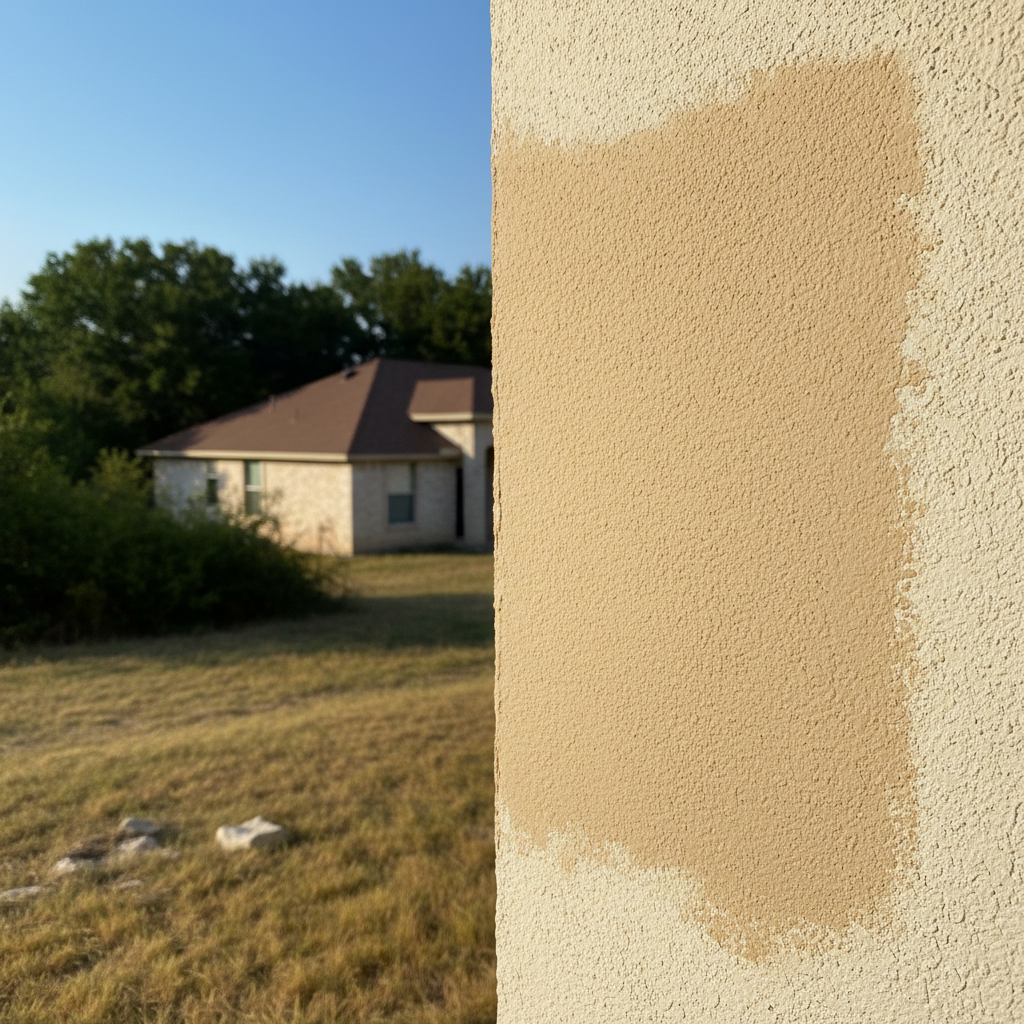
Not necessarily, but it's a common concern people have. The goal with any repair is to blend it in as seamlessly as possible. For minor repairs, especially on newer stucco, we can often match the existing color and texture so well that you won't even notice the repair. We carry a wide range of common stucco colors and can often custom-mix to get a close match. However, stucco naturally fades over time from sun exposure, especially here in Central Texas. If your stucco is several years old, even a perfect repair might stand out a little because the new material hasn't faded yet. In those cases, some homeowners choose to paint the repaired area, or even the entire wall or house, to ensure everything looks uniform. It's really a judgment call based on how old your stucco is, the size of the repair, and how particular you are about the aesthetics. We'll definitely discuss this during the estimate, and I'll give you my honest opinion on what's going to look best for your home.